
For Busy Readers
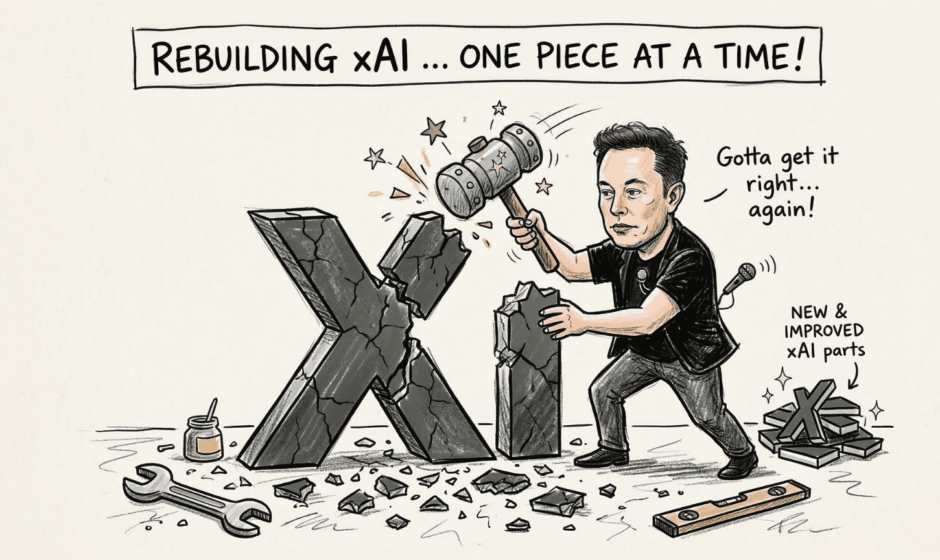
- Elon Musk recently admitted that xAI “was not built right” and has begun restructuring the company after leadership exits and product setbacks.
- In the global AI assistant market, Grok (xAI) holds only ~2.9% share, far behind competitors like OpenAI (~68%) and Google Gemini (~18%).
- Musk is now rebuilding xAI with talent from Tesla and SpaceX while trying to leverage distribution through the X platform.
The AI Race Musk Didn’t Want to Lose
Elon Musk has never liked losing technology races.
He helped start OpenAI in 2015, left the company in 2018, and later became one of its biggest critics. When generative AI exploded after ChatGPT’s launch, Musk responded with a rival: xAI.
The mission sounded ambitious.
Build an AI company capable of understanding the universe.
But within two years, the reality became more complicated.
Internal problems, talent departures, and weak competitive positioning pushed Musk to admit publicly that xAI was “not built right” and needed to be rebuilt from the ground up.
For a company competing in one of the fastest-moving industries in history, that admission is significant.
Because in AI, time matters more than almost anything else.
The Market xAI Is Competing In
The generative AI assistant market is already dominated by a few players.
Global AI Assistant Market Share (2026)
| Platform | Market Share |
|---|---|
| OpenAI (ChatGPT) | ~68% |
| Google Gemini | ~18% |
| DeepSeek | ~4% |
| Grok (xAI) | ~2.9% |
| Perplexity | ~2% |
| Claude (Anthropic) | ~2% |
| Microsoft Copilot | ~1.2% |
This data shows a simple reality.
xAI isn’t fighting for the lead.
It’s fighting for relevance.
While ChatGPT remains dominant, competitors like Gemini are rapidly gaining market share thanks to deep ecosystem integrations across browsers, operating systems, and productivity tools.
The Original Mistakes at xAI
Multiple factors appear to have slowed xAI’s early progress.
1. Talent Instability
Reports suggest that most of the original founding team has already left the company.
Only a small fraction of early leadership remains, with several researchers and executives exiting amid internal disagreements and burnout.
In AI companies, the founding research team often defines long-term innovation.
Losing them early can destabilize product direction.
2. Product Lag
xAI’s flagship model powers Grok, integrated into the X platform.
But Grok has struggled to match competitors in areas such as coding ability and reasoning performance.
Meanwhile, competitors rapidly improved.
- OpenAI shipped multiple GPT updates
- Google aggressively upgraded Gemini models
- Anthropic positioned Claude as an enterprise-safe model
This left Grok competing in a market where the performance bar keeps moving upward.
3. Distribution Without Ecosystem
One of Musk’s main advantages was supposed to be X (formerly Twitter).
But AI distribution today is happening through larger ecosystems:
- Google integrates Gemini into Android, Chrome, and Search
- Microsoft embeds Copilot into Windows and Office
- Apple is pushing AI into iOS and devices
- OpenAI is becoming the default AI tool for developers
xAI’s distribution through a social network alone turned out to be a weaker channel than expected.
What Competitors Are Doing Better
The companies ahead in the AI race share a few strategic advantages.
OpenAI: The Product Leader
OpenAI built the first AI product that millions of people use daily.
Strengths include:
- strong developer ecosystem
- enterprise integrations
- constant model upgrades
- large user base
Even with rising competition, ChatGPT still holds roughly two-thirds of the AI assistant market.
Google: The Distribution Giant
Google’s strategy is simple.
Embed AI everywhere.
Gemini now appears in:
- Google Search
- Android
- Gmail
- Google Docs
- Chrome
This ecosystem integration helped Gemini jump from about 5% market share to over 18% within a year.
Anthropic: The Enterprise Strategy
Anthropic positioned Claude as the enterprise-safe AI model.
Their focus includes:
- AI safety
- enterprise APIs
- long-context models
This helped them gain strong adoption among corporate users even with a smaller consumer presence.
How Musk’s Decisions Impacted xAI
Elon Musk’s leadership style has always been aggressive and fast-moving.
But in the AI industry, that approach comes with trade-offs.
Several decisions shaped xAI’s trajectory:
1. Late Market Entry
By the time Grok launched publicly, the AI market was already dominated by ChatGPT.
2. Social Platform Integration
Building Grok around X gave instant visibility but limited broader adoption.
3. Rapid Scaling
Trying to move quickly without stable internal structure reportedly created operational friction.
Musk himself acknowledged the structural issues.
Which is why he’s now trying something unusual in AI:
Rebuilding the company while it’s already operating.
The xAI Rebuild Strategy
Reports suggest Musk has started restructuring xAI in several ways.
New Talent
Teams from Tesla and SpaceX have been brought in to help stabilize operations and engineering culture.
Hiring From AI Startups
xAI has been recruiting engineers from high-performing AI coding startups to improve its model capabilities.
Infrastructure Expansion
Musk has hinted at large-scale compute investments tied to his broader ecosystem.
These could include:
- Tesla compute clusters
- SpaceX data infrastructure
- X platform distribution
The idea is to combine hardware, compute, and software distribution into one integrated AI ecosystem.
Why Musk Still Believes xAI Can Win
Despite the challenges, Musk’s bet on AI hasn’t changed.
In fact, he believes the AI race will eventually be decided by three factors:
- Compute power
- Data scale
- Distribution
Few founders control assets across all three layers.
Musk potentially does.
- X provides massive conversational data
- Tesla generates real-world AI training data
- SpaceX could support large-scale compute infrastructure
If those pieces are integrated effectively, xAI could evolve into something more powerful than just another chatbot company.
The Bigger Reality
The AI industry is moving faster than any previous technology wave.
Companies that fall behind rarely get a second chance.
Elon Musk is attempting exactly that.
Rebuilding an AI company while the market leaders are already accelerating.
Whether xAI becomes a major player or a footnote in the AI race will depend on one question:
Can it move faster the second time?
theCOMPYL Insight
The most interesting part of the xAI story isn’t the technology.
It’s the strategy.
Most AI startups are racing to build better models.
Musk is trying to build an entire AI ecosystem.
If it works, xAI could become a powerful infrastructure layer for Musk’s broader technology empire.
If it fails, it will show just how hard it is to catch up in the AI race.