


Automation is often sold as a magic bullet: cut costs, boost productivity, eliminate errors, and free up humans for higher‑value work. And for many companies, it does deliver those benefits — especially over the long term. But there’s a flip side that’s rarely talked about in marketing decks: automation can actually cost more than it saves, at least for some businesses and under certain conditions.
This article explores:
- Why automation sometimes backfires financially
- Real‑world costs and examples
- Emerging trends and projections
- What the future holds for automation economics
What Automation Promises – And When It Works
At its core, automation replaces or augments human effort with machines or software. In the right context, this can lead to:
- Higher throughput and consistent quality
- Reduced labor expenditure and human error
- 24/7 operations without downtime
- Faster data processing and decision‑making
These benefits can translate into savings of 20–30% in operational costs for some businesses — especially those with repetitive manual tasks and large volumes of predictable work.
But — and this is important — that’s not automatic. Benefits depend on how, where, and why the automation is implemented.
When Automation Costs More Than It Saves
1. High Upfront and Hidden Costs
Automation sounds exciting, but it comes with a price tag that goes far beyond the machine itself. You’re not just buying hardware or software—you’re investing in a whole ecosystem: connecting it to existing systems, upgrading infrastructure, training staff, and keeping it running smoothly.
In the real world, these costs often dwarf the sticker price. A factory robot isn’t just a robot—it’s safety barriers, sensors, conveyor adjustments, software tweaks, and more. Suddenly, what looked like a $50,000 purchase can easily balloon into $200,000.
For many mid-sized factories, these hidden costs are the reason automation feels out of reach. The lesson? Plan for the full picture before hitting “buy.”
2. Poor Process Selection — Automating the Wrong Things
Not every process deserves automation. One common misstep is automating tasks that simply don’t benefit enough from it.
If a task is:
- Rarely performed
- Quick to do manually
- Highly dependent on human judgment
…then automating it could end up costing more than it saves.
Take an approval workflow that happens just a few times a week. Sure, it looks impressive on paper—the ✨tech glamour✨ is real—but the payback period can stretch so long that the company might never see actual savings.ks great, but the payback period can stretch so long that the company might never see net savings.

3. Integration Headaches and Workflow Disruption
Even if an automated tool works in isolation, poor integration with legacy systems can create new iEven the best automation tool can stumble if it doesn’t play well with existing systems. Poor integration with legacy software can create new headaches: instead of saving time, teams end up spending hours troubleshooting connections, fixing data silos, and working around system clashes.
This tends to happen when:
- Automation tools aren’t built for your tech stack
- Multiple tools conflict with each other
- Data formats don’t line up
The result? A company might save a little time here and there, but those gains are quickly eaten up by lost productivity and extra IT work.
4. Skill Gaps and Workforce Costs
Automation isn’t plug‑and‑play. You need skilled people to design and maintain systems, troubleshoot breakdowns, and optimize workflows.
Finding—or training—that talent costs money, often more than many companies budget for. In fact, the shortage of skilled automation professionals is a major barrier for many firms, leaving projects stalled or automation underperforming.is a major barrier for many firms, which either stall projects or see automation underperform.
5. Over‑Automation and Loss of Flexibility
When companies automate too much, processes can lose flexibility. Machines are great at consistency, but they struggle with change. In operations that shift often—new products, different suppliers, seasonal workflows—automated systems can turn into expensive bottlenecks instead of efficiency boosters.
Manual work, by contrast, adapts naturally without costly reprogramming.
Real‑World Examples Where Costs Exceeded Savings
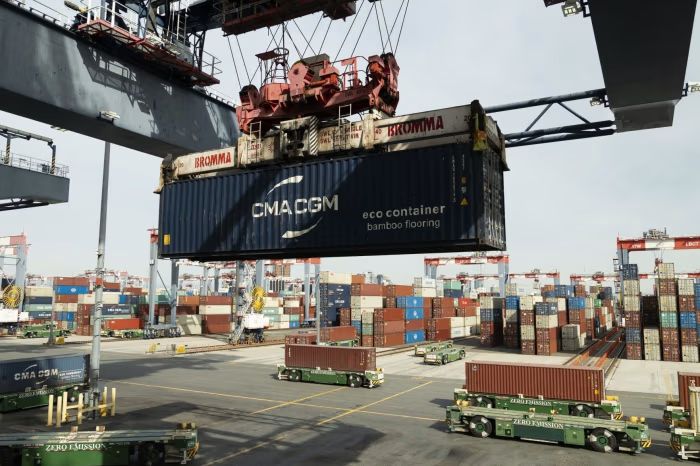
U.S. Ports and Logistics
Ports that adopted full automation with robotic cranes and autonomous trucks encountered challenges:
- Huge upfront costs
- Lack of flexibility during disruptions
- Labor resistance and skill shortages
Some terminals overestimated their cost savings due to poor coordination and inflexible systems, ultimately delivering lower productivity than expected.
This example highlights that being automated doesn’t always equate to being more efficient.
When Does Automation Actually Pay Off?
Automation starts saving money—rather than costing it—when the right conditions are in place:
- Tasks are repetitive, high-volume, and well-defined
- Mistakes are expensive (think finance or quality control)
- Human bandwidth is limited
- Systems are integrated thoughtfully, with ongoing monitoring
One survey found that organizations that move beyond early experimentation with intelligent automation can see around 32% cost savings once systems mature.
That said, hitting those numbers isn’t automatic. Success usually requires strategic planning, careful measurement, and continuous refinement. Automation pays off most when it’s approached deliberately, not as a quick fix.
The Bigger Picture: Automation Growth and Economics
Automation isn’t just a buzzword—it’s a booming industry.
The industrial automation market alone was worth hundreds of billions in 2024 and is set to grow rapidly over the next decade. Meanwhile, robotic process automation (RPA)—software that automates business workflows—is projected to jump from $3.8 billion in 2024 to nearly $31 billion by 2030, a staggering ~44% annual growth rate.
These numbers make one thing clear: companies are betting big on automation, not just for today, but for the years ahead. Learning how to implement it effectively isn’t optional—it’s becoming a critical competitive skill.
The Future: Automation That Pays and Scales
Analysts and reports show automation isn’t going away — it’s evolving. Market forecasts suggest that future automation systems will be:
1. Smarter and More Adaptive
Automation will increasingly combine:
- AI and machine learning
- Real‑time data feedback loops
- Predictive maintenance
This means systems can adjust themselves rather than waiting for human intervention, increasing both savings and resilience.
2. Integrated with Human Workflows
Rather than replacing humans, future automation is likely to augment them — especially in complex or judgment‑heavy tasks. This synergy reduces the chance of costly over‑automation.
3. Distributed Across Industries
From warehousing and manufacturing to finance, healthcare, and retail, automation will continue to spread — and with increased sophistication.
Some experts argue that many tasks currently done by humans might be automated by 2035, but human oversight will still be critical.
Takeaway: Don’t Automate Everything — Automate Smart
Automation can save money. It can boost productivity. It can transform whole industries.
But as these real‑world examples show:
- High upfront costs
- Poor process selection
- Integration complexity
- Workforce and skill gaps
can erase the expected savings — or even make automation more expensive than doing nothing.
In other words:
Automation isn’t inherently cheaper — the strategy around it determines whether it’s an investment or a cost center.
Thinking long term, automating the right processes while planning for integration, monitoring, and continuous improvement is what turns automation into cost savings — not just shiny technology for its own sake.
“Automation promised efficiency and savings — but in many companies, it quietly became the most expensive experiment they ever ran.”