
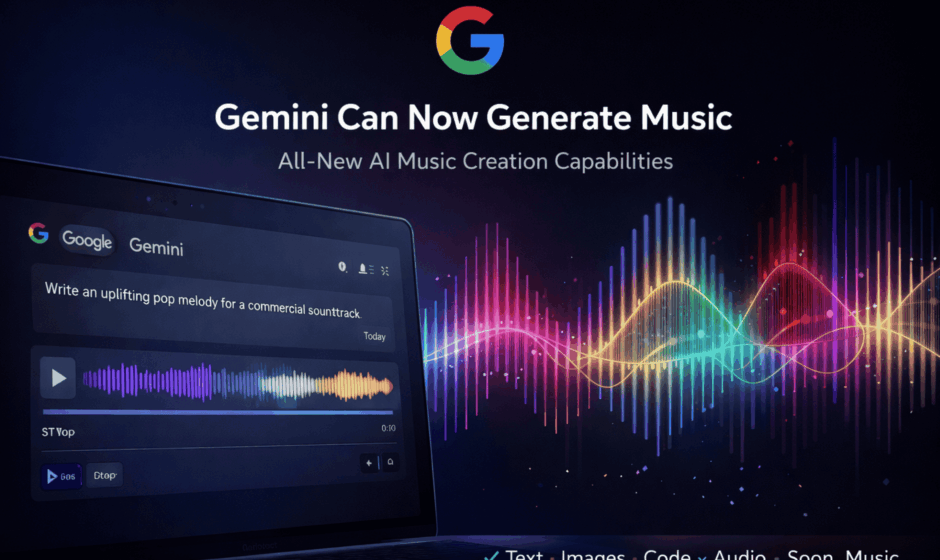

From writing emails to composing soundtracks, Gemini is quietly becoming a full-stack creative engine
For busy readers
- Google is expanding Gemini with music generation capabilities powered by its multimodal AI stack.
- Users will be able to create melodies, instrumental tracks and assistive music compositions directly inside Gemini.
- This move strengthens Google’s strategy of making Gemini a complete creative AI platform — not just a chatbot.
Gemini enters the music space
Google is reportedly adding music generation skills to Gemini, pushing the AI beyond text, images and code into full audio creativity.
This isn’t Google’s first experiment with AI music. The company has already developed music-focused AI models under its DeepMind research division. Now, those capabilities are being integrated into the consumer-facing Gemini ecosystem.
For years, AI tools focused on:
- Text generation
- Image creation
- Code writing
Music remained more niche and experimental.
That’s changing.
Gemini is moving toward being a multimodal creation platform, where users can generate:
- Text
- Images
- Code
- Video (in limited formats)
- And now — music
This is Google positioning Gemini as a serious competitor in the AI creative economy.
What Gemini’s music generation could look like
While details are still evolving, expected capabilities include:
? 1. Prompt-based composition
Users can describe a genre, mood, tempo or theme:
- “Create a cinematic orchestral background.”
- “Make a lo-fi beat for studying.”
- “Compose a short piano intro for a tech podcast.”
Gemini generates structured instrumental tracks accordingly.
? 2. Assistive music tools
Instead of full compositions, Gemini may:
- Suggest chord progressions
- Generate melody variations
- Add harmonies to user-created music
- Create background music for videos
? 3. Multimodal creativity
The most powerful angle: integration.
Imagine:
- Generate a YouTube script
- Create thumbnail art
- Write social captions
- Compose background music
All within Gemini.
That’s not a feature.
That’s an ecosystem.
What you can already do with Gemini
To understand why music matters, you need to see how far Gemini has already evolved.
1. Advanced text generation
Gemini handles:
- Long-form articles
- Business emails
- Research summaries
- SEO content
- Creative writing
Its reasoning capabilities have improved significantly in handling structured logic and nuanced prompts.
2. Image generation and editing
Gemini integrates with Google’s image models to:
- Generate photorealistic images
- Edit images via prompts
- Expand or modify visuals
For creators, this reduces dependency on external design tools.
3. Code generation and debugging
Gemini can:
- Write code in multiple languages
- Debug existing programs
- Explain complex algorithms
- Generate app structures
Developers increasingly use it as a coding co-pilot.
4. Data analysis and reasoning
Gemini can:
- Analyze spreadsheets
- Interpret charts
- Extract insights from PDFs
- Summarize reports
This pushes it beyond creativity into enterprise utility.
5. Multimodal understanding
One of Gemini’s biggest strengths is multimodal capability:
- Understand images
- Interpret audio
- Process documents
- Combine formats
Music generation becomes a natural extension of this capability.
Why Google is adding music now
This isn’t random timing.
1. The creator economy is expanding
Creators today need:
- Music
- Visuals
- Scripts
- Short-form content
- Ads
Google wants Gemini to be the one-stop creation engine.
2. Competing with AI creative platforms
Several AI platforms are entering:
- AI music generation
- AI video generation
- AI art tools
Google cannot afford to let creative AI leadership drift away.
By adding music, Gemini becomes:
Text + Image + Code + Audio + Video assistant.
That’s platform dominance.
3. AI as infrastructure, not feature
Google’s long-term goal is not “cool demos.”
It’s embedding AI into:
- Workspace
- Android
- Chrome
- Search
- YouTube
Music generation fits especially well with YouTube creators.
Imagine:
Upload video → Gemini generates background score → auto-publishes optimized content.
That’s vertical integration.
The bigger strategy: Gemini as the AI operating layer
Google isn’t just adding features.
It’s building Gemini as:
- An AI assistant
- A developer tool
- A creative suite
- A productivity engine
- A search augmentation layer
Music generation expands its creative bandwidth.
And importantly:
Audio AI is computationally expensive.
If Gemini handles it efficiently, Google strengthens its AI infrastructure advantage.
What this means for creators and businesses
For creators:
- Faster content production
- Lower music licensing costs
- Rapid experimentation
For startups:
- Build media apps without hiring composers
- Automate content pipelines
For enterprises:
- Custom brand jingles
- Internal media creation
- AI-driven marketing production
The barrier between idea and output keeps shrinking.
Final insight: AI is becoming creative infrastructure
A few years ago, AI helped write text.
Now it can:
- Write
- Draw
- Code
- Analyze
- Compose
Gemini adding music isn’t just a feature release.
It’s another step toward AI becoming the default creative engine of the internet.
And Google wants that engine to run on Gemini.