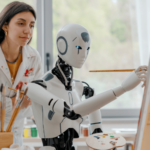


You’ve probably used an AI chatbot, had it finish a sentence for you, or maybe even argued with it about your favorite movie. It feels almost human sometimes, right? But here’s the truth: LLMs (Large Language Models) don’t understand the words like you do. They don’t “think” or “know” in the human sense. They are pattern machines, predicting what comes next based on everything they’ve seen. And yet, somehow, the result feels like magic.
Let me take you behind the curtain.
The Ghost in the Machine
Imagine reading a library of millions of books, scripts, and articles, trying to guess the next word in every sentence. That’s essentially what LLMs do—but on a scale humans can’t even fathom. Each word, sentence, and paragraph is transformed into a kind of numerical fingerprint, a vector that represents its “meaning” relative to every other word.
When the model generates text, it doesn’t know the story—it predicts, “Given everything I’ve read, this word or sentence fits next.” That’s it. Pure probability.
Yet, somehow, it writes essays, poetry, and even code that can make experts nod in awe—or scratch their heads in fear.
How They Learn — Months, Millions, and Trillions
Training an LLM is like sending a child through every book, email, Wikipedia page, and forum thread ever written, and then asking them to write convincingly about anything. But the child is a machine, with billions of neurons (or “parameters”), absorbing patterns non-stop.
Some of the largest LLMs took months on thousands of GPUs to train, costing millions of dollars. During this time, they learn grammar, facts, reasoning patterns, even subtle stylistic quirks—without ever “understanding” what they’re reading.
And just like a child, they can make mistakes—sometimes small, sometimes hilariously wrong, sometimes dangerously misleading.
Everyday Use Cases That Feel Like Science Fiction
LLMs are sneaky. They’re everywhere:
- Doctors use them to summarize patient records and draft reports faster than any resident could.
- Lawyers rely on them to scan mountains of contracts for risky clauses.
- Teachers and students generate practice questions, summaries, and explanations.
- Researchers get help drafting hypotheses, reviewing papers, and even writing snippets of code for simulations.
And yet, if you look carefully, in every use case, a human is still at the wheel—checking, correcting, guiding.
The Messy, Human Side of AI
Here’s where things get tricky: LLMs don’t just fail in predictable ways. They hallucinate—making up facts convincingly. They inherit biases from the humans who wrote the text they learned from. They forget context over long conversations, and they consume enormous energy to run.
And then there’s the perception factor. Humans are complicated:
- Some people trust them blindly.
- Some people dismiss them entirely.
- And some people oscillate between awe and skepticism every few minutes.
Designers are starting to realize that how we perceive LLMs shapes what we can safely do with them. AI is as much a social experiment as a technological one.
Where LLMs Could Go Next
Imagine an LLM that doesn’t just predict text, but understands your style, tone, and preferences, remembering past conversations while respecting privacy. Imagine it reading text, images, and audio seamlessly, giving you a single coherent answer.
That future is arriving, slowly. But it’s full of challenges: ethical dilemmas, hallucinations, bias, privacy concerns, and a race for compute power.
The Human Lesson
LLMs are mirrors. They don’t just reflect the text—they reflect us: our knowledge, biases, humor, mistakes, and creativity. They amplify our strengths, expose our weaknesses, and push us into a new kind of collaboration with machines.
Using an LLM is like having a co-writer who never sleeps, remembers everything, sometimes lies, and occasionally surprises you with brilliance. Your job isn’t to teach it facts—it’s to guide it wisely.
“LLMs don’t know the truth — they know what usually sounds right. And the future will depend on whether humans remember the difference.“