
For Busy Readers
- Most AI startups today are built on APIs from companies like OpenAI, Anthropic, and Google
- This creates a massive moat problem—anyone can replicate the core product
- The real value in AI isn’t in apps—it’s in compute, data, and distribution
The Illusion of Building AI
There’s a narrative dominating the tech ecosystem right now:
“We’re in the middle of an AI revolution.”
That part is true.
But what’s less discussed is who is actually building AI—and who is simply packaging it.
A large percentage of AI startups today don’t train models.
They don’t own foundational technology.
They don’t even control the intelligence layer.
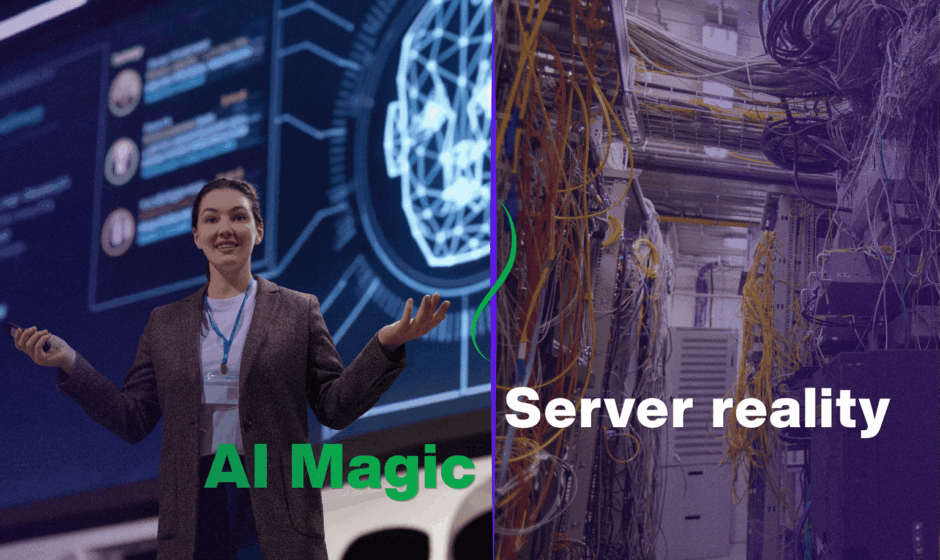
Instead, they sit on top of APIs from companies like OpenAI or Anthropic, wrapping them into products with better UX, niche workflows, or vertical positioning.
This isn’t necessarily a bad thing.
But it creates an illusion:
building an AI product is not the same as building AI.
The API Dependency Trap
At first, API-based development feels like a superpower.
- No need for massive compute
- No need for ML research teams
- No need for years of training data
You can launch fast. Ship fast. Scale fast.
But the same thing that makes it easy to build… makes it easy to replicate.
If your core product depends on an API:
- Your costs are externally controlled
- Your performance is externally dependent
- Your roadmap is indirectly dictated
And worst of all:
Your differentiation is fragile.
We’ve seen this before.
In previous tech cycles, companies built on platforms eventually faced the same reality:
If you don’t own the layer you depend on, you don’t control your future.
Where the Real Power Actually Sits
To understand where value is accumulating, you have to zoom out.
The AI stack today is quietly consolidating around a few key layers:
1. Compute (The Real Bottleneck)
Companies like NVIDIA and cloud providers like Amazon Web Services control the infrastructure required to train and run models.
This isn’t easy to replicate.
It’s capital-intensive, supply-constrained, and geopolitically sensitive.
2. Foundation Models
The likes of OpenAI, Anthropic, and Google are building the intelligence layer.
This is where:
- Research talent concentrates
- Training data accumulates
- Performance gaps emerge
3. Distribution
This is the most underestimated layer.
Who owns the user?
- Microsoft embedding AI into Office
- Google integrating AI into Search
- Platforms already controlling billions of users
Distribution is what turns capability into dominance.
The Coming Shakeout
Right now, the ecosystem is crowded with:
- AI writing tools
- AI design tools
- AI copilots for everything
Most of them:
- Use similar underlying models
- Solve similar problems
- Compete on superficial differentiation
This is classic early-cycle behavior.
Over time, three things will happen:
1. Margin Compression
If everyone uses the same APIs, pricing becomes a race to the bottom.
2. Platform Risk Becomes Real
API providers can:
- Change pricing
- Launch competing features
- Restrict access
And when they do, entire startups can collapse overnight.
3. Only Real Moats Survive
The companies that last will have:
- Proprietary data
- Strong distribution
- Deep workflow integration
- Or their own models
Everyone else becomes replaceable.
This Isn’t New — It Just Feels New
Every major tech wave goes through this phase.
- Early internet → thousands of websites, few survived
- Mobile apps → millions launched, handful dominate
- SaaS → crowded tools, only category leaders remain
AI is no different.
What’s different is the speed.
Because APIs compress the time it takes to build,
they also compress the time it takes to become irrelevant.
What Founders Should Actually Focus On
If you’re building in AI right now, the question isn’t:
“What can I build?”
It’s:
“What can I defend?”
That usually means:
- Owning unique data
- Embedding into critical workflows
- Building distribution early
- Or going deeper into the stack
Because in the long run:
wrapping intelligence is easy — owning it is not.
compylORIGINALS
The AI boom is real.
But so is the illusion inside it.
And the companies that understand the difference early…
are the ones that won’t disappear when the hype settles.