
For Busy Readers
- Artificial intelligence is rapidly moving beyond traditional software applications into hardware, media production, defense technology, and physical infrastructure.
- Major companies such as Nvidia, Netflix, and governments around the world are embedding AI deeper into core systems.
- The next phase of the AI revolution will likely be driven not just by models and apps, but by the industries AI transforms behind the scenes.
The Moment AI Left the Software World
If you had asked most technologists five years ago where artificial intelligence would transform the economy, the answers would have been predictable: search engines, social media, chatbots, maybe enterprise software.
But after covering technology for more than a decade, one pattern has become clear: the biggest technological revolutions rarely stay confined to software.
Artificial intelligence is now following the same path.
What began as machine-learning models running inside data centers is expanding into entirely new domains—semiconductor design, entertainment production, military strategy, and the physical infrastructure of the internet itself.
This transition marks a crucial turning point in the AI era.
AI is no longer just a tool.
It is becoming a foundational layer of modern industry.
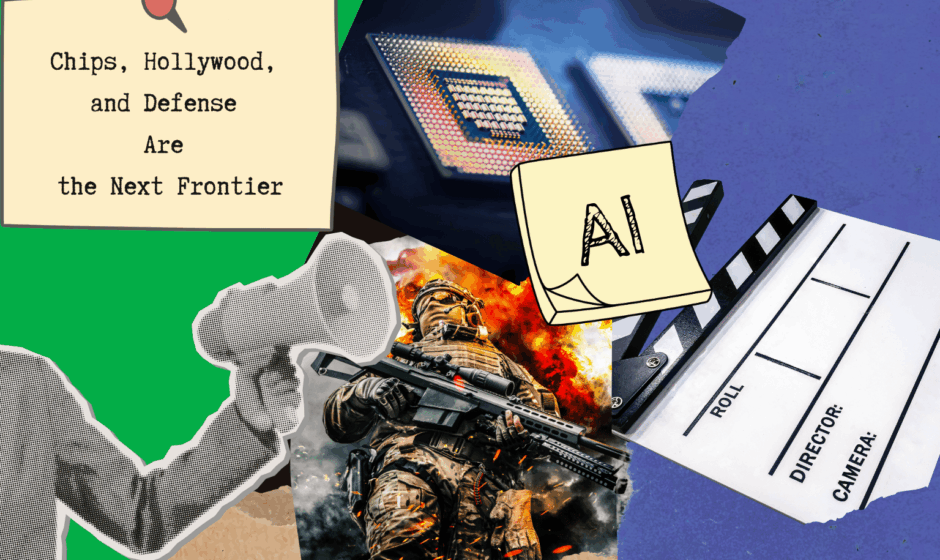
The New Battlefield: AI Chips
The most visible example of this shift is happening in the semiconductor world.
Companies like Nvidia have become the backbone of the AI boom, supplying the graphics processing units (GPUs) that power large language models and generative AI systems. But the demand for AI hardware has grown so rapidly that nearly every major technology company is now developing its own specialized chips.
Organizations including Google, Amazon, and Microsoft are investing billions into custom silicon designed specifically for AI workloads.
The reason is simple: training and running modern AI models requires immense computational power.
The companies that control the chips will increasingly control the economics of artificial intelligence.
This has turned the semiconductor industry into one of the most strategic battlegrounds of the global AI race.
Hollywood’s Quiet AI Revolution
Another industry experiencing rapid AI adoption is entertainment.
Streaming platforms such as Netflix are exploring AI tools that assist filmmakers with editing, visual effects, production planning, and even script development.
The technology is not replacing creative professionals—but it is reshaping how films and television content are produced.
AI can analyze thousands of hours of footage, suggest edits, automate complex post-production tasks, and dramatically accelerate workflows that previously took weeks or months.
In an industry where production costs are constantly rising, these tools could become essential for studios trying to scale content production.
The result may be the emergence of AI-assisted filmmaking pipelines, where creative teams collaborate with intelligent tools throughout the entire production process.
AI Moves Into the Defense World
Perhaps the most controversial expansion of AI is happening in national security.
Governments around the world are integrating artificial intelligence into military planning, intelligence analysis, and battlefield logistics.
AI systems can process satellite imagery, identify patterns across massive datasets, and provide decision-support tools that operate far faster than traditional human analysis.
This does not mean fully autonomous warfare is imminent. But it does mean that AI is becoming an increasingly important component of modern defense infrastructure.
The implications extend beyond technology.
They touch geopolitics, ethics, and the balance of global power.
The Infrastructure Layer of the AI Economy
Behind every AI system sits a massive physical network: data centers, fiber-optic cables, semiconductor fabs, and energy grids.
This infrastructure is becoming one of the most valuable assets in the technology sector.
Cloud providers such as Amazon Web Services, Microsoft Azure, and Google Cloud are investing billions into expanding AI-ready data centers capable of supporting the enormous computational requirements of next-generation models.
What we are witnessing is the construction of a new industrial layer for artificial intelligence—one that resembles the early days of the internet or the build-out of global telecommunications networks.
The Bigger Shift Few People Are Talking About
Much of the public conversation about AI still revolves around chatbots and consumer applications.
But the deeper story unfolding beneath the headlines is far more significant.
Artificial intelligence is moving from applications to infrastructure.
It is embedding itself into industries that shape the global economy—semiconductors, media production, defense systems, and digital infrastructure.
When technologies reach this stage, they stop being trends and start becoming foundations.
The companies and countries that control these foundations will likely define the next phase of the digital economy.