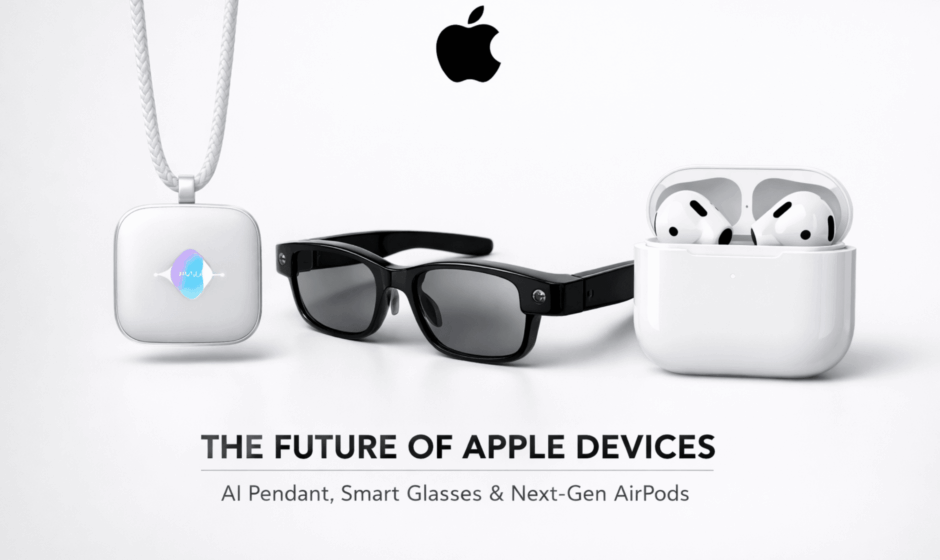

Pendant, AI glasses and next-gen AirPods — Apple’s next device wave is about ambient computing, not just hardware
For busy readers
- Apple is reportedly preparing three new AI-centric devices: a wearable pendant, AI-powered smart glasses, and next-gen AirPods.
- All three focus on ambient AI — devices that listen, see and assist continuously.
- The strategy: build an always-on personal AI ecosystem around users beyond the smartphone.
Apple’s next hardware phase: beyond the smartphone
For years, Apple’s product cycle revolved around iPhones, Macs and wearables like Apple Watch.
Now, the company is entering a new phase — ambient computing.
Instead of one primary device (the iPhone), Apple is building an ecosystem where multiple AI-enabled devices surround the user.
Three products reportedly in development:
- AI wearable pendant
- AI-powered smart glasses
- Next-gen AI-centric AirPods
This isn’t a random hardware expansion.
It’s Apple preparing for the post-smartphone AI era.
1. The Apple AI Pendant: your wearable assistant
What it is
Apple is reportedly working on a screen-minimal or screen-free wearable pendant designed to function as a personal AI assistant.
Think of it as:
- A wearable Siri device
- Always listening (with privacy controls)
- Voice-first interaction
- Context-aware AI assistant
It would likely be worn around the neck or clipped to clothing — similar in concept to emerging AI wearables but deeply integrated into Apple’s ecosystem.
Expected features
- Always-on voice assistant
- On-device AI processing
- Real-time translation
- Contextual reminders and notes
- Health and environment sensing
- Integration with iPhone, Watch and Vision ecosystem
This pendant is essentially Apple experimenting with screen-less computing.
Why Apple is building it
The long-term goal:
Reduce dependence on phones.
If AI can handle:
- Messages
- Search
- Scheduling
- Navigation
- Quick queries
…users may not need to unlock phones constantly.
Apple wants to own that layer before someone else does.
2. AI-Powered Apple Smart Glasses
What they are
Apple’s AI smart glasses are expected to be lighter and more practical than Vision Pro, designed for daily wear.
Unlike full AR headsets, these glasses will likely focus on:
- AI assistance
- Real-time information
- Camera + voice interaction
- Subtle AR overlays
Not a heavy headset — more like Ray-Ban Meta glasses, but deeply Apple-integrated.
Expected features
- Built-in cameras and microphones
- Real-time object recognition
- Live translation captions
- Navigation overlays
- AI assistant responses in audio or subtle visual prompts
- Seamless integration with iPhone and Apple ecosystem
These glasses will likely rely heavily on the iPhone for processing initially, before becoming more independent.
Why Apple wants smart glasses
Smart glasses are widely seen as the next major computing platform after smartphones.
Apple doesn’t want Meta or Google dominating this space.
The strategy is clear:
Start with lightweight AI-first glasses → eventually move to full AR glasses.
Vision Pro was step one.
These AI glasses are step two.
3. Next-Gen AI AirPods
AirPods may become Apple’s most important AI device.
Not because of music — because of voice and context.
What Apple is reportedly adding
Future AirPods could include:
- Advanced AI voice assistant
- Real-time translation
- Health sensors (temperature, heart rate, posture)
- Environmental awareness
- Gesture controls
- Always-available AI queries
AirPods already sit in users’ ears for hours daily.
Apple wants them to become the primary interface for AI interaction.
Why AirPods matter most
AirPods solve a major problem:
AI assistants need constant access to users.
Ear-based devices allow:
- Instant communication
- Discreet responses
- Continuous context
In many scenarios, AirPods could replace phones as the main way users interact with AI.
Apple’s larger strategy: Ambient AI ecosystem
These three devices aren’t isolated launches.
They form a coordinated strategy.
1. Move from device-centric to human-centric computing
Instead of one primary device (phone), Apple is building multiple devices around the user:
- On body (pendant)
- On face (glasses)
- In ears (AirPods)
- In pocket (iPhone)
This creates continuous interaction with Apple AI.
2. Reduce reliance on the iPhone — slowly
Apple won’t kill the iPhone anytime soon.
But it wants a future where:
Users interact with AI through wearables first, phones second.
The pendant, glasses and AirPods are early steps toward that shift.
3. Competing in the AI hardware race
Big Tech is entering AI hardware aggressively:
- Meta → AI glasses
- OpenAI + hardware partners → AI wearables
- Google → AI-first Pixel ecosystem
Apple cannot rely only on software.
It needs physical AI devices embedded in daily life.
4. Privacy-first AI as differentiation
Expect Apple to push:
- On-device AI
- Private processing
- Secure personal data handling
While competitors focus on cloud AI, Apple will market private personal AI.
That positioning could become its biggest advantage.
Timeline: when could these launch?
Based on supply chain and industry signals:
- AI AirPods: likely first (within next product cycle)
- Smart glasses: expected within 1–2 years
- AI pendant: experimental, possibly limited release first
Apple typically tests new categories quietly before scaling globally.
Why this matters for the tech industry
If Apple succeeds, the shift will be massive.
We move from:
Smartphone-centric computing → ambient AI computing
Devices won’t just be tools.
They’ll become continuous companions powered by AI.
And Apple wants to own that relationship before anyone else.