

For busy readers
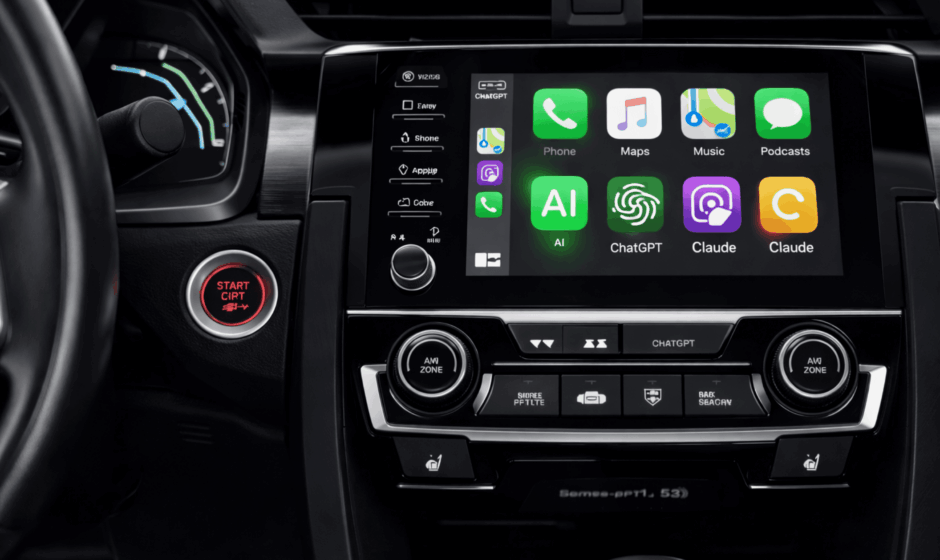
- Apple is integrating AI chatbot compatibility into CarPlay, letting users interact with services like ChatGPT directly from their dashboard.
- The shift reflects a broader trend where voice and conversational AI are replacing touch and menus in cars.
- Competitors like Google’s Android Auto and vehicle makers (Mercedes, GM, Tesla) are also embracing AI — meaning the cockpit of the future will be defined by conversation, not buttons.
Where we are now: screens, buttons, and Siri limitations
For years, Apple’s CarPlay has been the go-to way iPhone users bridge their digital life with their car’s dashboard. It gives you:
- maps and navigation
- messages and calls
- music and podcasts
- some apps adapted for touch-safe interaction
But CarPlay has always been fundamentally menu-driven, with Siri offering voice shortcuts that are helpful but basic:
“Send a message to Mom.”
“Play my workout playlist.”
“Where’s the nearest gas station?”
Siri handles these well — but it lacks deep conversational understanding, context retention, and the open-ended reasoning that makes AI chatbots so sticky and useful off the road.
That gap is what Apple seems determined to close.
The news: CarPlay meets AI chatbots
In late 2025, Apple began signaling that CarPlay would soon be compatible with external AI chatbots, including generative models like those powering ChatGPT. While Apple hasn’t called out any brand directly, the implication is clear: your dashboard assistant will soon understand you more deeply than before.
Rather than:
“Play Taylor Swift”
You could say:
“Tell me the best scenic route to take for dinner tonight and send Sarah an ETA — oh, and factor in gas stations along the way with good coffee.”
That’s not a command — that’s a conversation.
In Apple’s chessboard, this isn’t just a feature — it’s a pivot toward dialogue-first interaction when driving.
What this means for driving UX
? Voice becomes the primary control surface
Touchscreens demand eyes-on-road. Voice lets your hands stay on the wheel and eyes forward. Traditional menu hierarchies are replaced by context-aware replies.
? Context retention changes expectations
Right now, Siri often treats every request as a fresh start. AI chatbots remember context, meaning follow-ups feel natural:
“Find Italian restaurants near here.”
“Filter ones with outdoor seating and jazz music.”
“Book a reservation for 7:30.”
That’s a huge leap from “next nearest stop.”
The competition: who’s already there
Apple isn’t alone in this race.
Google / Android Auto
Google has baked its Assistant into Android Auto for years, and its AI roadmap is tightly integrated with Gemini — a model designed to work across:
- search
- maps
- Assistant
- Photos / docs
Android Auto isn’t as polished as CarPlay in some cars, but Google’s strength lies in ecosystem breadth and head-to-head AI capability.
Tesla
Tesla’s infotainment OS already pushes beyond basic commands with its voice interface, and Elon Musk’s companies (including xAI) place AI at the center of experience. Tesla could leap ahead with conversational AI if it integrates xAI models directly into the cockpit.
Legacy automakers
Companies like Mercedes-Benz, BMW, GM, and Renault are increasingly partnering with AI providers to embed assistants that can handle:
- route planning
- vehicle diagnostics
- personalized driver profiles
Many use cloud-based AI that feels smart — but the biggest leap forward is still in natural dialogue rather than scripted responses.
Why this matters — beyond convenience
? This could reshape the app landscape
Navigation apps, messaging apps, even vehicle settings could become secondary to conversation. If you can ask “what’s the best route that avoids traffic and roadwork” and get nuanced reasoning instead of a simple reroute, apps will have to compete on understanding, not buttons.
?? Enterprise usage in cars
Imagine corporate fleets where your AI assistant:
- summarizes meeting prep while you commute
- flags changes in agenda
- files expense reports by voice
That moves voice assistants into work companion territory, not just car helper.
? Safety and trust
Voice interfaces reduce distraction — but only if they:
- understand context accurately
- avoid hallucinations
- confirm actions before execution
This becomes a UX and safety priority, not an optional convenience.
What Apple (and others) need to get right
This shift isn’t plug-and-play. To make conversational AI in cars truly safe and useful, companies need:
? Reliable offline fallbacks
Cars move through dead zones. The system must maintain context and capability even when connectivity dips.
? Privacy-first design
Automotive AI may process extremely personal information — destinations, payment intents, personal messages. Users must trust that this data is local and protected.
? Intent clarity
Voice recognition isn’t enough — AI has to parse intent reliably:
- Understand ambiguity
- Ask clarifying questions
- Confirm actions that have real impact (sending messages, changing routes)
? Context awareness
Car AI has to know:
- where you are
- what you’re doing
- what you probably intend
without being creepy.
This demands sensors, location data, and context models working together.
Could this change the market?
Absolutely — and quickly.
- Drivers will care less about app buttons and more about conversational power.
- Developers will shift from navigation APIs to intent APIs.
- Automakers will compete on dialogue quality, not just screen polish.
- CarPlay and Android Auto could become AI conduits, not just app wrappers.
In other words: the interaction paradigm in cars could shift from tap-driven to talk-driven — and that change would ripple across:
- navigation
- entertainment
- messaging
- in-car productivity
- fleet management
Even the way cars are marketed might change:
“Comes with conversational AI cockpit assistant”
could become a headline feature.
Strategic insight
The road ahead isn’t just about hands-free convenience. It’s about human-friendly intelligence that understands you in motion.
We’ve spent decades learning how to interact with screens. Now we’re headed toward systems that learn how to interact with us — even when we’re driving.
That’s a big leap — and one Apple clearly doesn’t want to be late to.
Final thought on redefining Car’s Interface
The interface that got us here was a screen and a finger.
The one that will define what’s next — in our cars, our homes, and maybe even our lives — could very well be our voice.
And soon, we’ll expect it to understand us back.