


Most of us use the internet all day — on phones, laptops, TVs, watches — without ever seeing what actually happens underneath. Even people with years of experience in tech often carry a fuzzy mental model.
So let’s slow it down.
Let’s follow one simple action:
You type
google.comand press Enter.
Step 1: Your Device Asks a Question (Not the Internet Yet)
The moment you hit Enter, your device doesn’t “go to Google.”
It asks a very specific question:
“What is the IP address of google.com?”
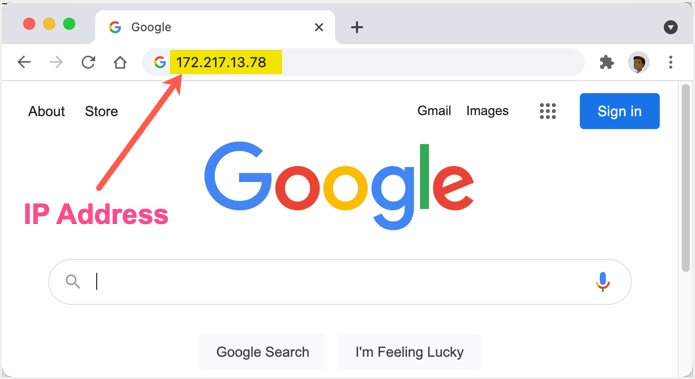
Computers don’t understand domain names. They understand IP addresses — long numbers like 142.250.190.14.
The name google.com is just for humans.
So your device turns to the DNS system — the internet’s phonebook.
Step 2: DNS — The Internet’s Most Important Invisible System
DNS (Domain Name System) answers one question only:
“Which IP address belongs to this name?”
Here’s how that lookup really works:
- Your device asks your router
- Router asks your ISP’s DNS server
- If unknown, it asks:
- Root DNS servers
- Then TLD servers (
.com) - Then authoritative servers (the final source)
Only then does it get the IP address.
Fun fact:
DNS has no idea what a website looks like. It only knows names → numbers.
Step 3: Where Companies Like GoDaddy Actually Fit In
This is where domain registrars like GoDaddy come in.
They don’t host your website.
They don’t send your data.
They don’t show your pages.
They simply:
- Register domain names
- Point domains to DNS records
- Manage ownership and expiration
Think of them as property registration offices, not builders or delivery services.
Step 4: Packets — The Internet Never Sends “A Page”
Now your device knows the IP address. Time to talk to the server.
But here’s the surprise:
The internet never sends full messages.
Everything is broken into tiny packets.
Each packet contains:
- A piece of data
- Source address
- Destination address
- Order number
These packets:
- Take different routes
- May arrive out of order
- May get lost and re-sent
Protocols like TCP/IP quietly handle all of this — reordering, retrying, validating.
You never see the chaos. That’s by design.
Step 5: Routers — The Silent Traffic Police
Packets don’t travel in a straight line.
They hop through:
- Home router
- ISP routers
- National backbones
- International fiber cables
- Data center routers
Every router asks:
“Where should I send this next right now?”
This decision changes millisecond by millisecond depending on congestion, failures, or speed.
Fun fact:
A request from India to the US may cross oceans, satellites, and multiple countries — and still return in under 200ms.
Step 6: The Server Finally Responds
The destination server:
- Receives your packets
- Reassembles the request
- Processes it (search, database, logic)
- Sends response packets back
Those packets return the same chaotic way — different paths, reordered, corrected — until your browser quietly reconstructs everything into a web page.
To you, it feels instant.
Behind the scenes, it’s controlled disorder.
Step 7: Your Router — The Unsung Hero at Home
Your router:
- Assigns local IPs to devices
- Translates private → public IPs (NAT)
- Manages Wi-Fi traffic
- Filters junk requests
Every phone, TV, laptop, speaker in your house shares one public internet identity because of it.
Why the Internet Feels “Always On” (But Isn’t)
The internet:
- Has no central control
- Has no single owner
- Has no master switch
It survives because:
- Everything is redundant
- Failures are expected
- Routes constantly adapt
That’s why outages happen locally, not globally.
Now, Let’s talk about some mind blowing facts :
- Email can arrive before the webpage that sent it.
- Two packets from the same request may never meet again.
- DNS failures can break the internet without breaking servers.
- Submarine cables carry 99% of global internet traffic.
- The internet was designed assuming parts would fail constantly.
The Real Takeaway
The internet doesn’t work because it’s perfect.
It works because it assumes nothing will be.
Every click is a global collaboration between devices, routers, cables, protocols, and servers — most of which you’ll never see, and none of which know who you are.
And yet, it delivers.
‘The internet isn’t fast because it’s simple.
It’s fast because it’s incredibly good at handling chaos.Every click you make is a quiet collaboration between millions of systems that don’t know you — yet work together just for you.’
“So yes, the internet is broken sometimes — and somehow, that’s exactly why it works.“