

When you’re building a startup, the cloud feels like a superpower. Infinite servers, global reach, pay-as-you-go pricing — everything you need to move fast.
But here’s the catch: the wrong cloud choice won’t break you on Day 1 — it’ll hurt you quietly over time.
This isn’t a feature checklist.
This is a real-world, startup-first comparison of the major cloud platforms — what they’re good at, where they hurt, and which type of startup they actually fit.
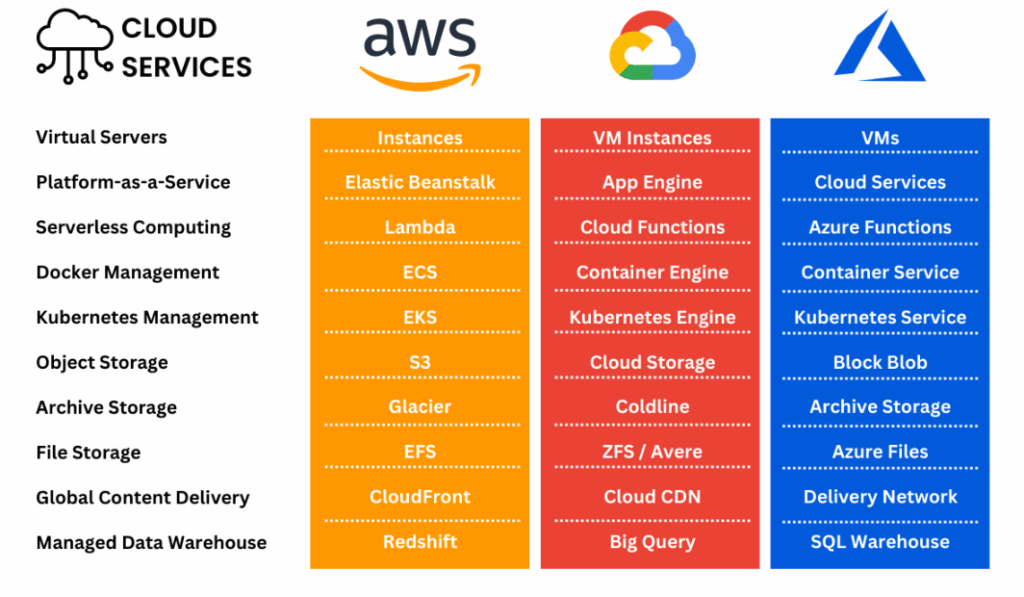
The Big Three (and One Wildcard)
For most startups, the conversation comes down to:
- Amazon Web Services (AWS)
- Microsoft Azure
- Google Cloud Platform
- DigitalOcean (popular with early-stage teams)
Let’s break them down the way founders, engineers, and CFOs experience them.
AWS — The Default Choice (for a Reason)
Why startups choose AWS 
AWS is the most mature cloud platform in the world. If you imagine a service, AWS probably already has three versions of it.
Strengths
- Massive service ecosystem
- Excellent scalability (from MVP to IPO)
- Strong startup credits and accelerators
- Industry-standard for DevOps talent
Where it hurts
- Pricing is complex (easy to overspend accidentally)
- Too many services = decision fatigue
- Requires disciplined cost monitoring
Best for
- SaaS startups
- Marketplaces
- Fintech, Healthtech, Enterprise-focused products
Founder reality
AWS won’t limit your growth — but it will punish carelessness.
Azure — Best if You’re Selling to Enterprises
Why startups choose Azure
Azure shines when your customers are already living inside Microsoft’s world.
Strengths
- Deep integration with Microsoft tools (Office, Active Directory)
- Strong enterprise trust
- Hybrid cloud is a big win
- Preferred by large corporations and governments
Where it hurts
- Documentation can feel scattered
- Less intuitive for small, fast-moving teams
- UI and services feel enterprise-heavy
Best for
- B2B SaaS
- Enterprise IT products
- Startups selling to regulated industries
Founder reality
Azure wins deals before your product demo even starts — because IT teams already trust it.
Google Cloud — The Engineer’s Favorite
Why startups choose Google Cloud
Google Cloud is loved by engineers, especially teams working with data, AI, and analytics.
Strengths
- Best-in-class data and AI tools
- Clean, developer-friendly experience
- Transparent networking and pricing
- Excellent Kubernetes support
Where it hurts
- Smaller ecosystem than AWS
- Fewer third-party integrations
- Less enterprise penetration (compared to Azure)
Best for
- AI/ML startups
- Data-heavy products
- Developer-first platforms
Founder reality
Google Cloud feels elegant — but you may need to work harder on sales credibility.
DigitalOcean — The Startup Playground
Why startups start here
DigitalOcean is simple, fast, and friendly — especially for early-stage teams.
Strengths
- Extremely simple pricing
- Clean UI, easy onboarding
- Great documentation
- Predictable monthly costs
Where it hurts
- Limited advanced services
- Scaling beyond a point requires migration
- Not ideal for complex architectures
Best for
- Early MVPs
- Indie hackers
- Bootstrapped startups
Founder reality
DigitalOcean helps you ship fast — just don’t assume it’ll scale forever.
Cost Comparison (Startup Reality)
| Platform | Early Stage Cost | Scaling Cost | Cost Transparency |
|---|---|---|---|
| AWS | Low (credits help) | Can spike fast | Complex |
| Azure | Medium | Predictable | Medium |
| Google Cloud | Medium | Competitive | Clear |
| DigitalOcean | Very Low | Limited scaling | Very clear |
Truth:
Cloud doesn’t become expensive because it’s powerful —
it becomes expensive because nobody is watching it.
How Startups Should Actually Decide
Ask these questions before choosing:
- Who is your customer?
Enterprises → Azure
Developers → GCP
Everyone → AWS - How fast will you scale?
Unsure → AWS or GCP
Predictable → Azure or DigitalOcean - How technical is your team?
Small team → DigitalOcean
Strong DevOps → AWS / GCP - What’s your 3-year vision?
IPO-scale → AWS / Azure
Niche product → GCP / DO
What This Means for the Industry
- Startups are moving from cloud-first to cost-aware cloud
- Multi-cloud and hybrid setups are becoming normal
- AI workloads are pushing founders toward specialized clouds
- Cloud choice is now a strategic decision, not just a technical one
In the next 5 years, we’ll see fewer “one-cloud-for-everything” startups — and more intentional, workload-based cloud strategies.
Choosing a cloud platform is a lot like choosing a co-founder. The right one grows with you and helps you scale. The wrong one won’t fail you overnight—it’ll slowly drain time, money, and focus.
The smartest startups know when to commit—and just as importantly, when it’s time to change.
“Because breaking up with a bad co-founder is hard — breaking up with a bad cloud is harder.“