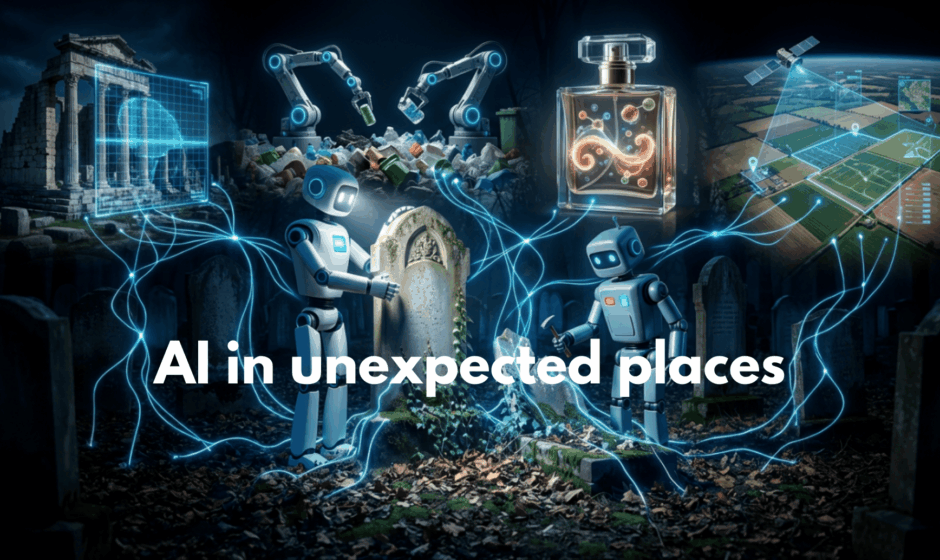

When people talk about AI, the same industries show up every time: tech, finance, healthcare, marketing. Predictable. Comfortable. Almost boring.
But behind the scenes, AI has quietly slipped into places no one thought it belonged. Industries that still smell like soil, steel, paper, sweat, and tradition are now running on models, sensors, and algorithms.
This isn’t futuristic. This is already happening.
And once you see it, you can’t unsee it.
1. Cemeteries & Funeral Services
Yes. Even here.
How AI is used
- Optimizing burial plot allocation decades in advance
- Predicting maintenance needs of graveyards
- Digital legacy planning (memorial data, photos, voice archives)
- Demand forecasting for funeral services
Why it exists
Urban land is limited. Cemeteries operate on 50–100 year horizons. AI helps plan for timeframes humans can’t mentally simulate.
Why people don’t talk about it
Because no one wants to associate AI with death — yet planning is unavoidable.
2. Ports, Shipping Yards & Maritime Logistics
Not ships — ports.
Port of Rotterdam
Orbcomm
What AI does
- Predicts ship arrival times using weather + tide + traffic
- Optimizes container stacking to reduce re-handling
- Detects port congestion days in advance
- Prevents fuel waste and idle time
The Port of Rotterdam runs a digital twin powered by AI to simulate port activity before it happens.
Why it matters
A one-hour delay at a major port can ripple across global supply chains.
3. Sports Refereeing & Rule Enforcement
Not analysis — judgement.
How AI is used
- Offside detection in football
- Line calls in tennis
- Player movement rule violations
- Bias reduction in refereeing decisions
Why it’s controversial
Fans trust humans emotionally — but trust AI statistically.
Hidden truth
AI doesn’t replace referees. It protects them from impossible expectations.
4. Religious Institutions & Faith Management
Quietly adopting tech.
What AI helps with
- Analyzing community engagement patterns
- Predicting attendance and donation trends
- Translation of religious texts across languages
- Digital preservation of manuscripts
The Vatican has actively engaged with AI ethics frameworks — not to reject AI, but to guide it.
Why it’s unexpected
Faith is emotional. AI is logical. Yet institutions still need operations.
5. Luxury Watchmaking & Craftsmanship
Handmade — assisted by machines.
Where AI fits
- Detecting microscopic defects invisible to humans
- Predicting component failure over decades
- Counterfeit detection
- Supply chain authentication
Why it works
When a product lasts generations, quality prediction matters more than speed.
6. Archaeology & Historical Research
Digging without digging.
University of Cambridge
Google DeepMind
AI use cases
- Satellite image analysis to locate buried structures
- Reconstructing damaged manuscripts
- Translating extinct or fragmented languages
- Predicting where ruins may exist underground
AI has helped locate lost Roman roads without excavation.
Why it’s powerful
It preserves history instead of destroying it through trial digging.
7. Food Taste & Flavor Engineering
Not recipes — chemistry.
What AI actually does
- Predicts how flavor compounds interact
- Designs plant-based alternatives that mimic real food
- Optimizes texture, aroma, and aftertaste
- Reduces trial-and-error lab testing
AI doesn’t cook. It simulates taste mathematically.
8. Tattoo Design & Body Art
Where permanence meets prediction.
AI applications
- Visualizing tattoos on skin before ink
- Predicting aging, stretching, and fading
- Style matching based on body shape and skin tone
Why it matters
Mistakes are permanent. AI reduces regret.
9. Real Estate Valuation for Slums & Informal Housing
Not luxury apartments — the opposite.
What AI enables
- Valuing properties without formal documentation
- Disaster risk assessment
- Urban planning in unstructured regions
- Insurance access for underserved communities
Why it’s powerful
AI brings financial visibility to places maps ignored.
10. Language Preservation & Dying Dialects
Saving voices before they vanish.
UNESCO
Meta AI
How AI helps
- Recording and reconstructing endangered languages
- Generating learning materials
- Translating oral traditions
- Voice preservation
Some languages survive today only because AI archived them.
The Real Pattern
AI doesn’t show up in industries because they’re trendy or modern. It shows up where things are messy, fragile, hard to scale, or quietly breaking under pressure.
In fact, the less glamorous the industry, the more quietly powerful AI tends to be.
“AI didn’t invade these industries. It just showed up, did the work, and stayed out of the spotlight — which might be the most intelligent move of all.”